We load optional analytics or site-identification tools only after you consent. You can choose each purpose separately and reopen these settings from the footer at any time.
A fuller picture of the company, before you commit.
Every commercial relationship depends on knowing who you are dealing with. Yet a company profile or website rarely gives the full picture.
What We Help You Understand
We examine legal entity details, registration and operating records, ownership structures, related companies and publicly documented business activity. Our research helps clients understand a potential partner’s background, identify inconsistencies between sources and recognise risks that warrant further verification.
Where It Matters
Before clients sign a contract, make an advance payment or enter a long-term relationship, our aim is to reduce information gaps and clarify the key questions that remain. We want important commercial decisions to rest on a fuller understanding of the facts.
CI-001
Research Exhibits
Modelled scenarios, structured evidence and conditional assessments.
Illustrative Research Exhibit — Simulated Data
Corporate Structure & Evidence Network
Research Context
A cross-border trading business is assessing a proposed contract with synthetic Entity E05. The analysis reconstructs ownership and associated records, then isolates information that requires verification before agreement or payment.
Assessment Scope
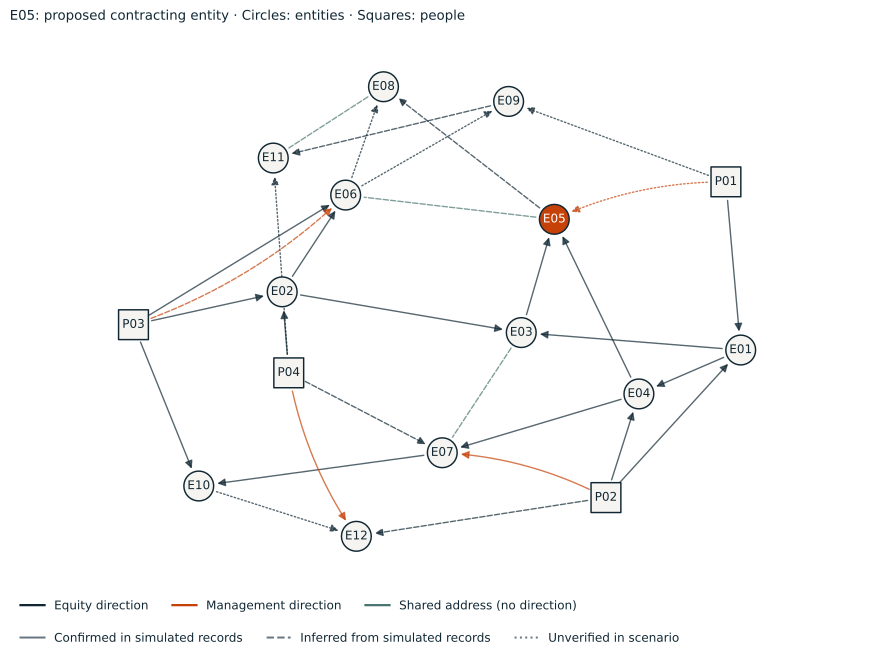
Closed synthetic network: 16 entities and people, 31 relationships, 14 events and 90 source entries. Network analysis and record consistency support verification planning; they do not establish legal control or performance capacity.
CI-01
Corporate Relationship Network
Scroll horizontally to inspect the complete figure.
NetworkX links 16 simulated entities and people through 31 recorded relationships. Direction denotes ownership or management; shared addresses are non-directional associations. Connectivity is not a risk score.
Scroll horizontally to inspect the complete figure.
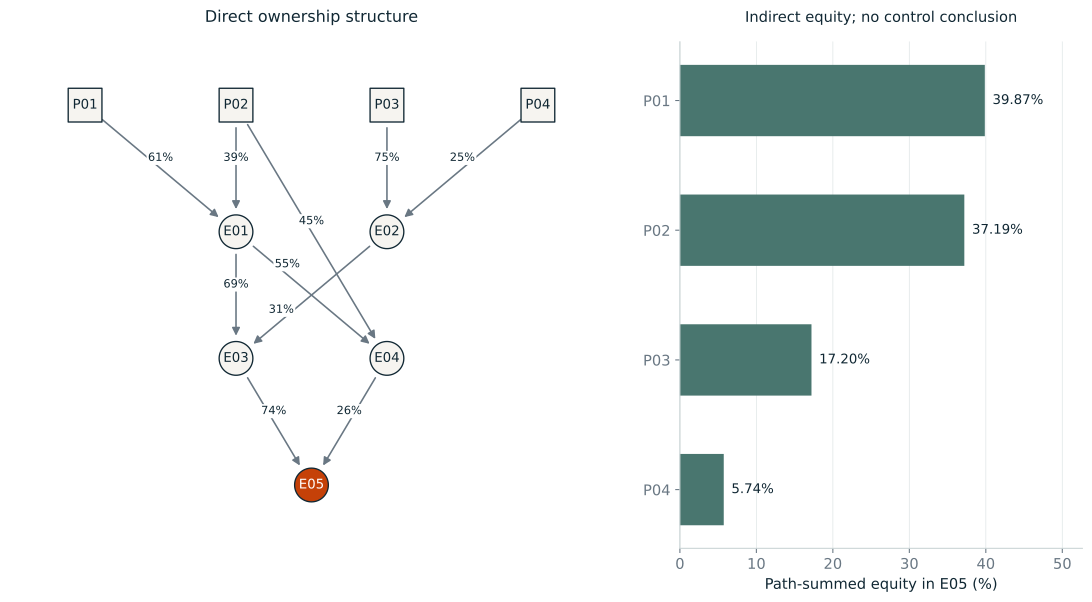
7 acyclic ownership paths connect four natural persons to E05. Each path multiplies its edge percentages; paths are summed by owner. Aggregate equity is 100%. Voting rights and actual control remain outside scope.
Scroll horizontally to inspect the complete figure.
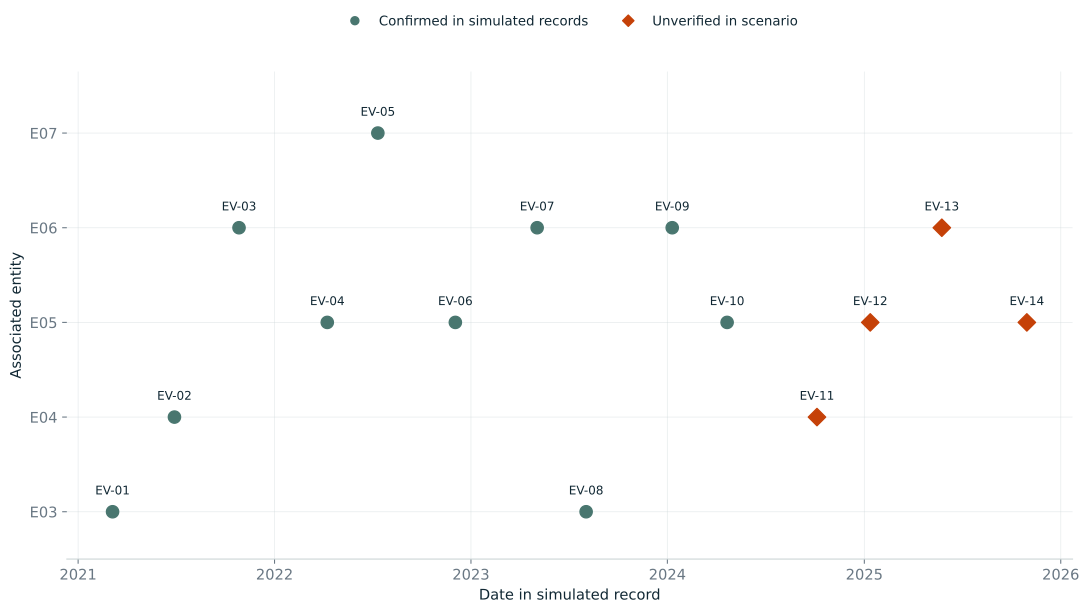
14 dated event records retain entity, source and verification status. Event proximity does not establish causal or legal relationships. The companion table identifies each event.
Scroll horizontally to inspect the complete figure.
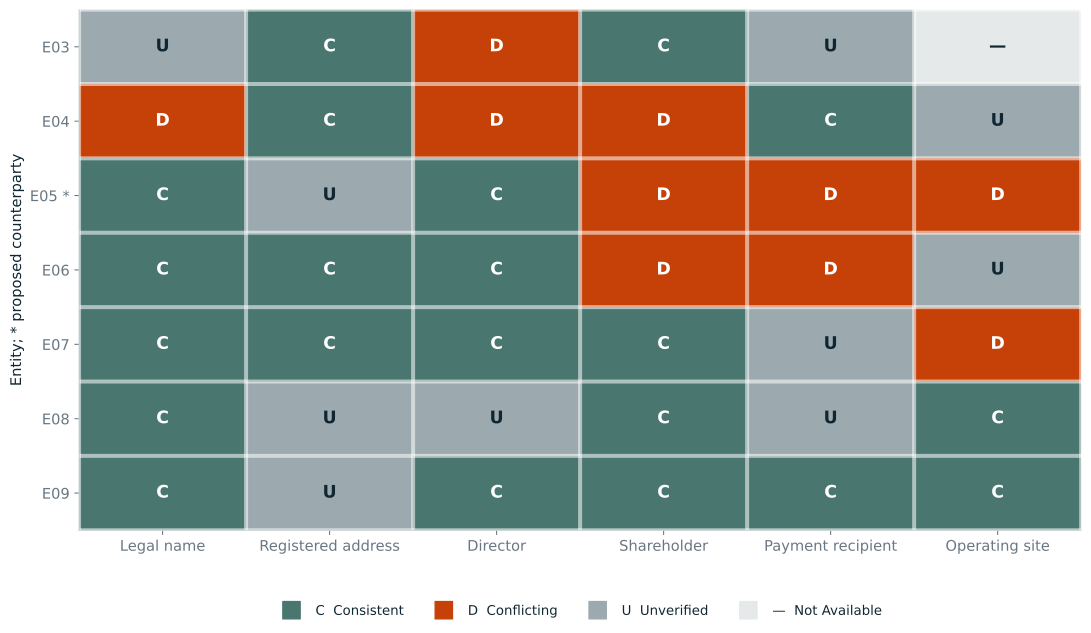
90 source entries are joined across seven entities and six fields. Disagreement, insufficient verification and unavailable records are classified separately. A conflicting record is a verification requirement, not proof of misconduct.
Corporate structure: P01 holds the largest path-summed interest in E05 (39.87%). This is calculated equity exposure in a fully allocated acyclic scenario, not a legal-control finding.
Evidence consistency: E05 has 2 consistent fields, 3 conflicting fields, 1 unverified fields and 0 unavailable fields. Payment-recipient records contain 2 distinct values across 3 sources.
Transaction implications: the simulated E05/E06 payment-recipient difference requires confirmation of beneficiary authority and contract alignment. Shared address and network position alone provide no basis for an adverse conclusion.
Ownership Path Calculation
Owner
Path to E05
Edge fractions
Indirect equity
P01
P01 > E01 > E03 > E05
61% x 69% x 74%
31.1466%
P01
P01 > E01 > E04 > E05
61% x 55% x 26%
8.7230%
P02
P02 > E01 > E03 > E05
39% x 69% x 74%
19.9134%
P02
P02 > E01 > E04 > E05
39% x 55% x 26%
5.5770%
P02
P02 > E04 > E05
45% x 26%
11.7000%
P03
P03 > E02 > E03 > E05
75% x 31% x 74%
17.2050%
P04
P04 > E02 > E03 > E05
25% x 31% x 74%
5.7350%
Public Records Chronology — Simulated Entries
Record
Date
Entity
Event
Evidence status
EV-01
2021-03-06
E03
Entity registration
Confirmed in simulated records
EV-02
2021-06-29
E04
Entity registration
Confirmed in simulated records
EV-03
2021-10-27
E06
Entity registration
Confirmed in simulated records
EV-04
2022-04-09
E05
Entity registration
Confirmed in simulated records
EV-05
2022-07-12
E07
Entity registration
Confirmed in simulated records
EV-06
2022-12-03
E05
Shareholding filing
Confirmed in simulated records
EV-07
2023-05-04
E06
Management appointment
Confirmed in simulated records
EV-08
2023-08-03
E03
Address record update
Confirmed in simulated records
EV-09
2024-01-10
E06
Business scope filing
Confirmed in simulated records
EV-10
2024-04-21
E05
Management appointment
Confirmed in simulated records
EV-11
2024-10-05
E04
Address record update
Unverified in scenario
EV-12
2025-01-12
E05
Counterparty form submitted
Unverified in scenario
EV-13
2025-05-25
E06
Counterparty form submitted
Unverified in scenario
EV-14
2025-10-30
E05
Payment details submitted
Unverified in scenario
Executive Interpretation
The model identifies 7 ownership paths to E05 and a payment-recipient discrepancy across three simulated sources. The largest indirect interest belongs to P01 at 39.87%, which does not establish actual control. Contracting and payment should remain conditional on consistent legal-entity and beneficiary records, with unresolved information treated as a verification gap rather than an adverse finding.
Decision Conditions
Confirm the proposed signatory, legal counterparty and payment recipient against current authorised records before contract or payment approval.
Reconcile every conflicting field to dated source documents; obtain independent support for single-source records. Escalation depends on the materiality of the unresolved item, not graph centrality.
Assess voting agreements, nomination rights and nominee arrangements separately if actual control is relevant to the transaction.
Evidence Limitations
Every entity, event, shareholding and source record is simulated. No external registry, client file or real-world allegation is represented.
Equity calculation assumes a closed, fully allocated ownership DAG. Cross-holdings, nominees, unequal voting rights and contractual control are excluded.
Record consistency is not substantive truth. Absence of information is not evidence of misconduct, insolvency or inability to perform.
Our Perspective
We believe trust rests on more than promises. It also rests on facts that stand up to verification.
Scope and working agreements
Our desk-based company screening is not a statutory audit, legal opinion or certification of a counterparty. Conflicting or unavailable records are flagged for further verification, not treated as proof of misconduct.
Commission a defined project or agree an ongoing research partnership. A written Statement of Work (SOW) confirms the question, evidence boundaries, deliverables, currency, taxes, payment terms and timing. Unless the SOW says otherwise, work begins after official confirmation and receipt of the agreed payment. Additional work requires written agreement.
Discuss your project
Identify what to verify before a commitment.
Tell us about the potential partner and the contract or payment you are considering. We can discuss which background information and risk indicators need examination.