We load optional analytics or site-identification tools only after you consent. You can choose each purpose separately and reopen these settings from the footer at any time.
Digital Trust Infrastructure After the Proliferation of AI-Generated Content
As the cost of content generation falls, high-responsibility contexts increasingly need to explain source, handling process, verification path, and accountability. Proof chains do not replace fact-checking, but they may change how content is accepted, cited, reviewed, and challenged.
Proof verifies origin, not truthProof does not equal truthsource review through 2026-06-14
Executive Judgment
As content becomes easier to generate, credibility depends more on proof chains
Proof of Reality does not primarily ask whether AI content looks real. It asks how society can establish source, handling process, issuing responsibility, and review path when content enters fact judgment, identity confirmation, transactions, public communication, or institutional acceptance.
Core Judgment
Source records, signatures, labels, verification interfaces, and governance workflows can reduce some information asymmetry. At the same time, signing authority, interpretive authority, interface authority, and rule-setting authority may remain concentrated.
Core Boundary
A proof chain can support judgment about source and handling path; it cannot automatically prove that a claim is correct, an emotion is authentic, or a conclusion is reliable. Low-responsibility expression should not be over-proofed.
Reader Decision Test
When does content need a proof path?
Low ResponsibilityEmotion, imagination, aesthetics, and personal experience can prioritize expressive value.Public CommunicationWhen content shapes public understanding, reputation, and group judgment, source and edit history become more important.Transaction and IdentityWhen identity, authorization, contracts, assets, credentials, careers, or institutional endorsement are involved, the proof path becomes necessary.Institutional RelianceWhen courts, regulators, platforms, finance, media, or institutions rely on content, the proof chain needs to enter auditable workflows.
Proof Infrastructure Stack
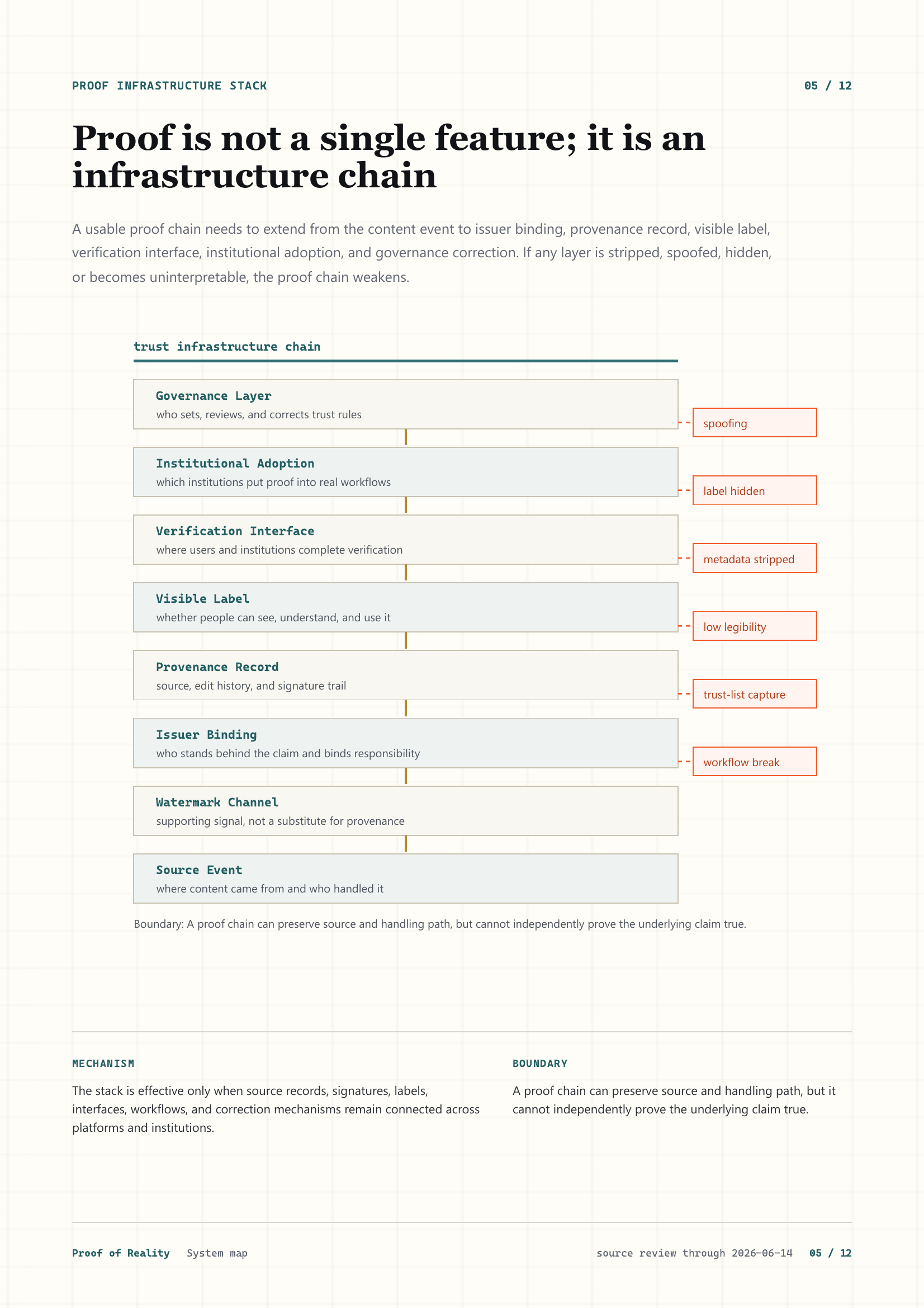
Proof is not a single feature; it is an infrastructure chain
A usable proof chain needs to extend from the content event to issuer binding, provenance record, visible label, verification interface, institutional adoption, and governance correction.
Scenario System Map
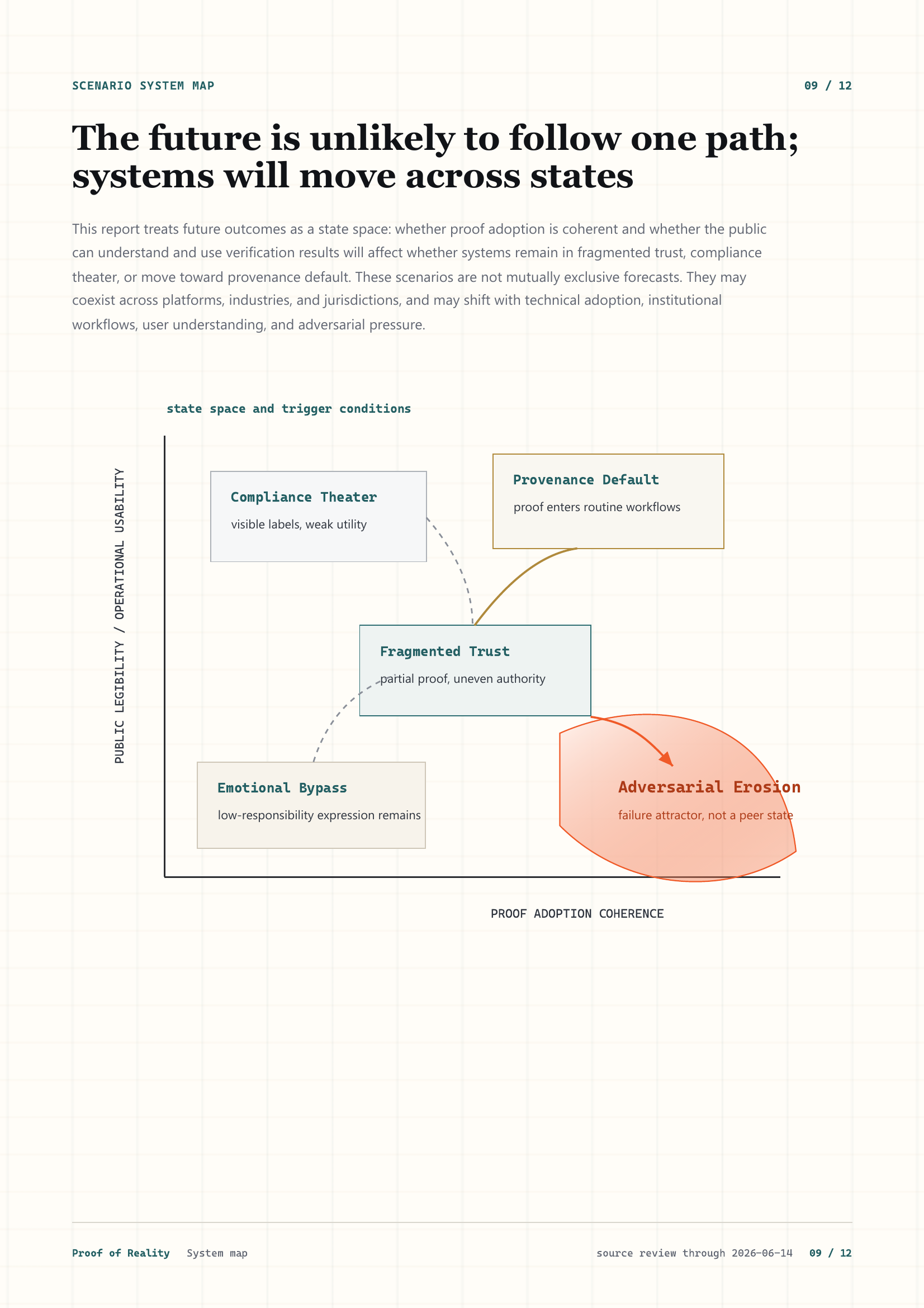
The future is unlikely to follow one path; systems will move across states
The scenario map expresses a state space, not mutually exclusive forecasts. Proof adoption coherence and public legibility shape how systems move across trust states.
Transition Logic
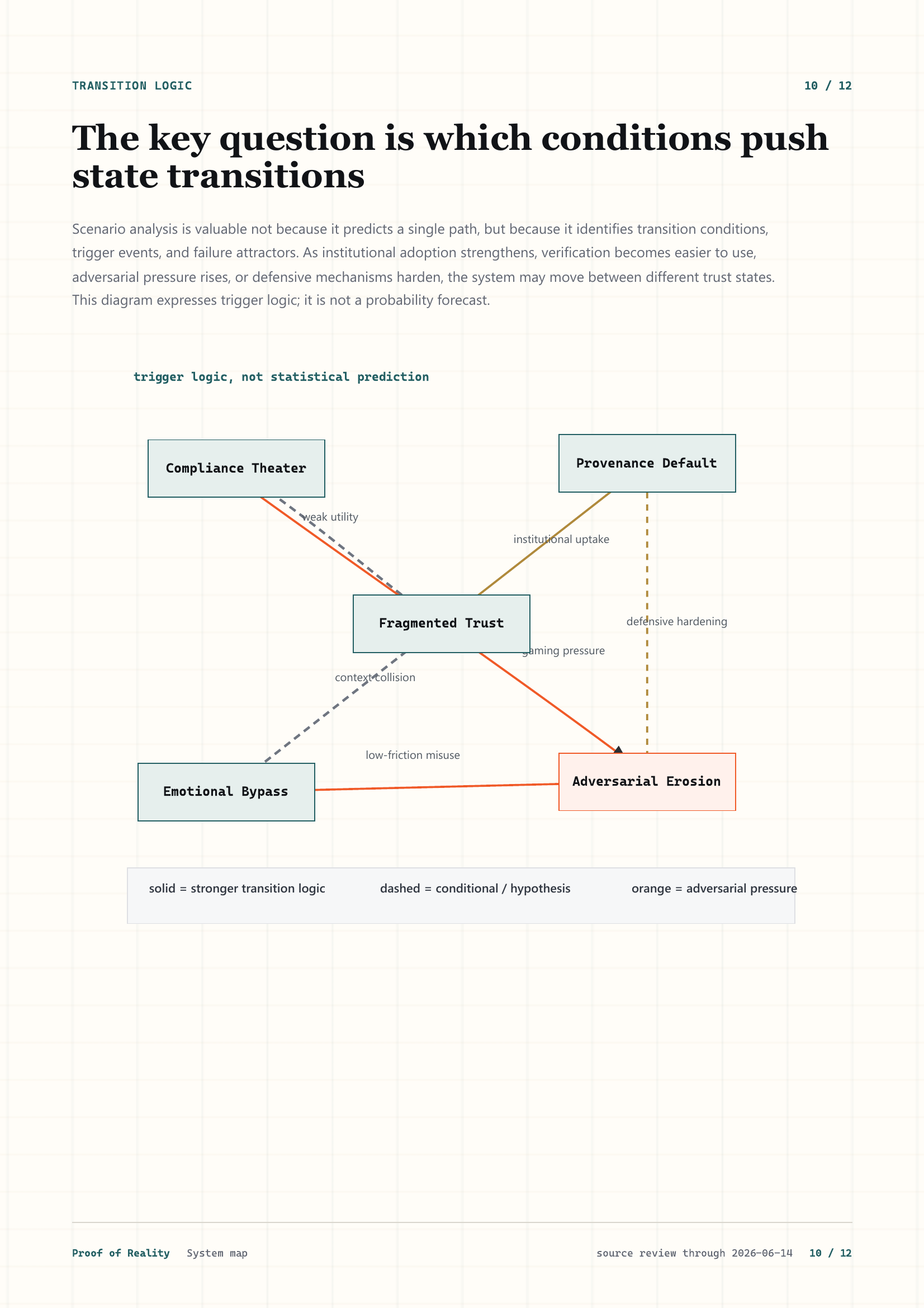
The key question is which conditions push state transitions
The transition diagram identifies transition conditions, trigger events, and failure attractors. It is not a probability or statistical forecast.
Evidence Boundary
Credible reporting must deliver judgment and boundary at the same time
This report separates facts, inferences, hypotheses, recommendations, and boundaries to avoid presenting structured judgment as unqualified fact. Scenario and transition diagrams express trigger logic; they are not probability or statistical forecasts.
Text Boundary
Only discusses source, acceptance, and accountability in high-responsibility contexts; it does not create a universal proof requirement for all AI content.
Review Trigger
Update or correction review should be triggered when major standards, platform implementation, regulatory interpretation, verification tools, or large-scale spoofing events materially change.