
Systems & Scenarios TAIWHA-001
Global Food Systems and Agricultural Input Risks
Energy and fertilizer markets, country evidence, and risks to food supply.
The assessment
Executive assessment
Agricultural-input risk depends on which constraint binds and when it occurs. The report documents divergent market prices and distinct country transmission channels, while its conditional scenarios show how weather, delivery delays and trade constraints can compound pressure. Procurement, production support and household assistance should therefore be assessed against crop calendars, executable supply and local affordability. Scenario results support comparison of mechanisms; they do not establish event probabilities or validated national harvest forecasts.
PRINCIPAL FINDINGS
Principal findings
- Observation
The market observations cited in the report show a sharp rise in the European gas benchmark alongside divergent fertilizer-price movements, including a decline in urea.
Implication An international energy quotation cannot stand in for every fertilizer product, the price paid by farmers or the quantity available locally. The observed divergence does not establish a universal causal pass-through rate.
- Observation
The country records identify different exposure channels: fertilizer delivery and application timing in Kenya; administered prices, subsidies and stocks in India; and planting calendars plus offsetting acreage and yield changes in Brazil.
Implication These are contrasting case studies, not a representative sample or a ranking of national risk. Dispatch announcements do not establish timely farm delivery, and the Brazilian harvest decomposition does not identify the cause of the yield change.
- Institutional projection
The USDA outlook cited in the report projects a narrower global grain stock buffer, while still indicating aggregate reserves. The report also notes a different maize-inventory assessment from FAO-AMIS.
Implication These are institution-specific projections at their respective release vintages. Aggregate stocks do not guarantee local delivery or affordability, and figures with different definitions or denominators should not be combined into a single risk ranking.
- Model result
In the report's conditional model, simultaneous weather, planting and import constraints produce larger crop-output deviations than input-price pressure and moderate quantity restrictions alone.
Implication The results depend on the selected parameters, crop calendars and static reference state. They are stress comparisons, not forecasts of national year-on-year harvest changes, consumer-price inflation or the probability of a food crisis; independent country-level predictive validation remains incomplete.
- Inference
The report's policy assessment calls for tracking supplier acceptance, contract execution, physical delivery and the remaining crop window separately, alongside household food affordability.
Implication Modeled benefits from earlier sourcing also depend on supplier assumptions and accompanying measures. Higher crop output does not consistently imply lower price pressure or stronger household purchasing power, so the scenarios do not identify one universally preferred policy package.
Research atlas
RESEARCH ATLAS / 01
Scenario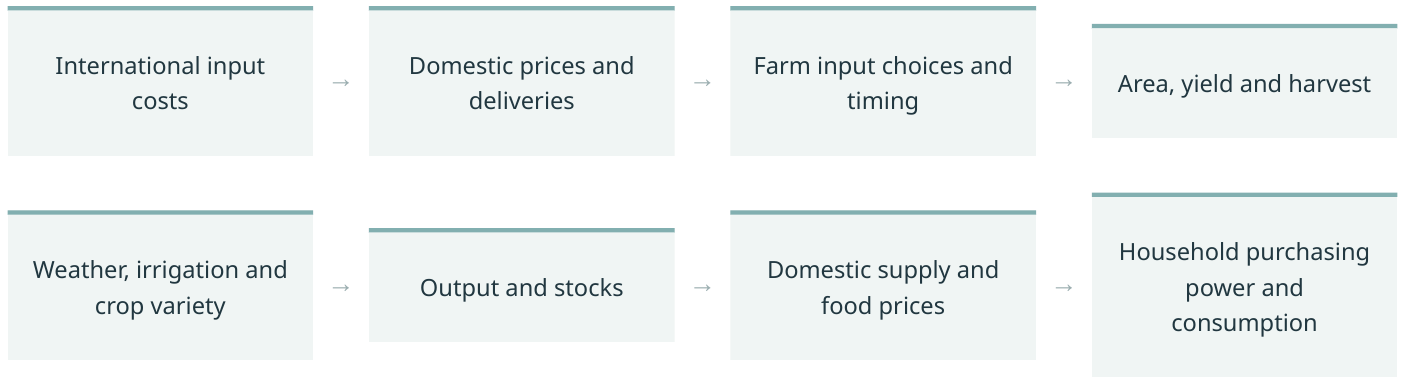
Transmission mechanisms in the food system. The diagram connects input costs, deliveries and farm choices with harvests, food prices and household purchasing power.
- Units
- Qualitative transmission framework
- Timeframe
- Research cutoff: 19 October 2026
Reading note The arrows describe the report’s analytical framework, not independently established causal effects. Input prices, physical delivery and household affordability remain distinct constraints.
DECISION RELEVANCE
Why this matters
- Match input subsidies, stock releases, alternative sourcing and household assistance to the constraint they address.
- Kenya: track county fertilizer receipts, farm delivery and application timing alongside local maize prices.
- India: monitor subsidy implementation, local fertilizer stocks, irrigation and spring wheat weather together.
- Brazil: connect soybean-harvest timing, maize planting, fertilizer availability and export decisions.
RESEARCH APPROACH
Research approach
- Compare historical energy, fertilizer and grain prices, including lagged relationships estimated with monthly regressions.
- Examine Kenya, India and Brazil through crop calendars, input availability, public support, local markets and grain balances.
- Simulate production, inventories, price pressure and household purchasing power under alternative shocks and policies, including supplier acceptance and implementation delays.
Limitations
Price regressions describe historical associations, not isolated causal shocks. Scenarios are conditional experiments, not forecasts or probability estimates, and national crop-output results have not been independently validated against multi-year country data.